

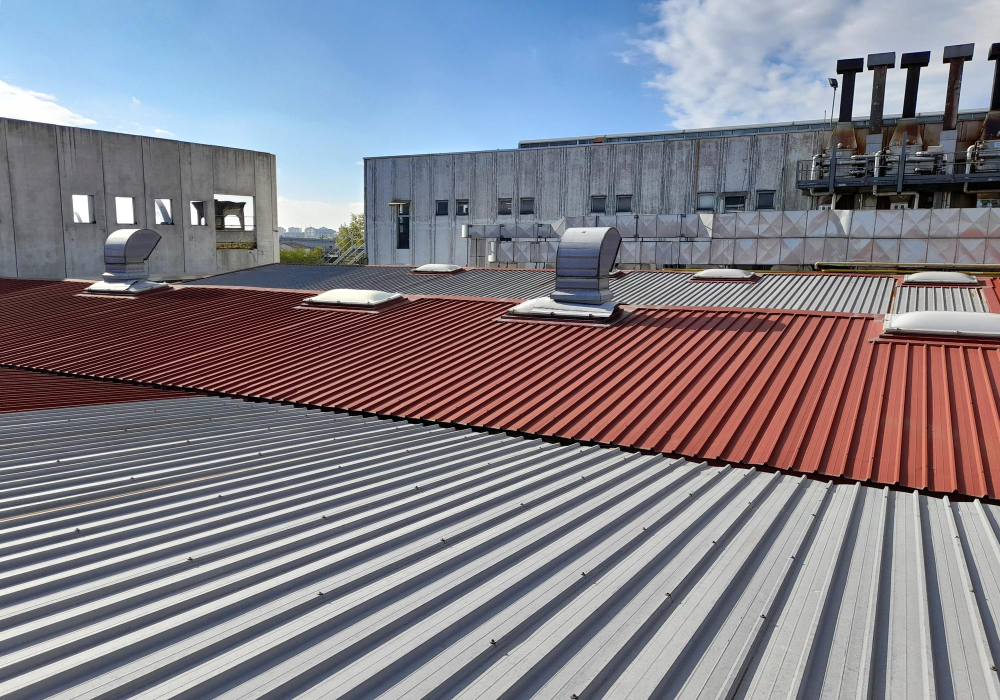
Overview: Start With Roof Condition, Not Assumptions
A ceiling stain does not automatically mean a commercial roof has reached the end of its useful life. Water can enter through a localized problem involving flashing, seams, penetrations, membrane damage, roof edges, or other vulnerable details. On the other hand, repeatedly repairing an extensively deteriorated system can create its own problems. Several individually affordable repairs may eventually represent a significant investment in a roof that continues to produce new failures.| Factor | Targeted Roof Repair | Roof Replacement |
|---|---|---|
| Typical Scope | Specific damaged or vulnerable areas | Broad roofing system |
| Initial Cost | Generally lower | Generally higher |
| Project Scope | Usually smaller and more localized | More extensive planning and construction |
| Best Fit | Serviceable roof with isolated problems | Widespread or recurring deterioration |
| Long-Term Strategy | Preserves an existing viable system | Resets a larger portion of the roofing lifecycle |
Option A: Targeted Commercial Roof Repair
Repair is most attractive when an inspection identifies a defined problem while the surrounding roof remains in serviceable condition. Examples might include localized membrane damage, deteriorated flashing, vulnerable penetrations, or specific seam conditions. The important word is localized. A repair should address an identified cause rather than become another layer of patching over an unresolved problem.Pros of Commercial Roof Repair
- Lower initial expense: You address the affected area rather than undertaking a full replacement.
- Smaller project scope: Localized work can often be coordinated more easily around building operations.
- Preserves a viable roof: A serviceable system does not necessarily need replacement because of one repairable defect.
- Supports planned budgeting: Repairs may provide time to prepare financially for larger future roofing work when appropriate.
Cons of Commercial Roof Repair
- Repairing one location does not eliminate unrelated deterioration elsewhere.
- Recurring repairs can become expensive over time.
- Extensive hidden deterioration may make localized work less practical.
- A repair-first strategy can delay an unavoidable replacement if the overall roof condition is poor.
Option B: Commercial Roof Replacement
Replacement enters the conversation when the issue extends beyond one damaged detail. A commercial roof experiencing repeated leaks across multiple locations, widespread material deterioration, numerous aging repairs, or broader system problems deserves a different financial analysis. The upfront investment is greater, but concentrating resources on a comprehensive project can make more sense than repeatedly funding isolated work on a system that continues to deteriorate.Pros of Roof Replacement
- Broader solution: Replacement addresses extensive roofing deterioration rather than individual failures.
- Better long-range planning: Owners gain a clearer starting point for future inspection and maintenance cycles.
- Opportunity to address system details: The project can incorporate flashing, penetrations, drainage-related details, insulation considerations, and other relevant components within a coordinated scope.
- Fewer legacy repairs: Owners are no longer relying on an accumulation of patches from different periods.
Cons of Roof Replacement
- Higher upfront investment than localized repair.
- More extensive scheduling and project coordination.
- May be unnecessary when the existing roof is fundamentally serviceable.
- Requires careful planning around tenants, customers, equipment, access, and business operations.
Side-by-Side Comparison: Which Option Fits Your Building?
The most useful comparison is not simply “cheap versus expensive.” Instead, evaluate what each investment accomplishes relative to the condition of the roof.| Roof Condition or Property Goal | Repair | Replacement | Likely Advantage |
|---|---|---|---|
| Single isolated leak | Strong candidate | May be excessive | Repair |
| Recurring leaks in several areas | May become repetitive | Worth evaluating | Replacement / Inspection |
| Roof otherwise in good condition | Preserves existing system | Potentially unnecessary | Repair |
| Widespread deterioration | Limited value if failures continue | Addresses broader condition | Replacement |
| Need time for future capital planning | May help when technically appropriate | Requires larger immediate budget | Repair, if condition permits |
| Extensive history of patching | Additional repairs may have diminishing value | Creates a broader reset | Replacement / Inspection |
Leave a Reply